The Power of Letter Tracing Pages for Toddlers
You know that moment when a toddler first picks up a crayon. It’s not just scribbles; it’s the beginning of a journey toward communication. For parents, educators, and creators, supporting that journey is both a passion and a practical challenge. That’s where a structured resource like Letter Tracing Pages for Toddlers comes into play. It’s more than just a worksheet—it’s a foundational tool designed to guide little hands through the shapes and motions that form our alphabet.
Building Skills Beyond the Page
Imagine a preschool teacher preparing for the morning session. With a class of energetic three-year-olds, having a consistent, ready-to-use activity is crucial. Letter Tracing Pages for Toddlers provides exactly that: a clear, repetitive practice that reinforces the correct way to write each letter. It’s not about perfection; it’s about building motor memory. Each trace of an ‘A’ or a ‘b’ strengthens fine motor control and hand-eye coordination, skills that are essential not only for handwriting but for buttoning coats, using utensils, and other everyday tasks.
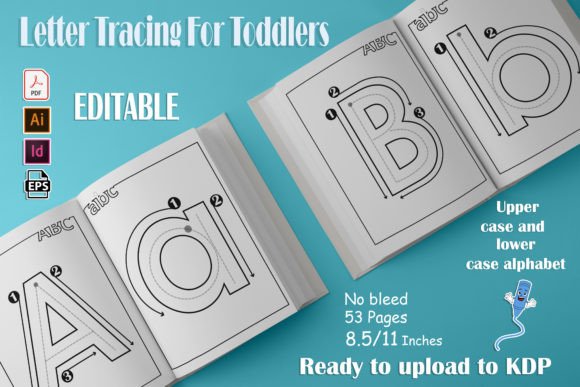
For a homeschooling parent, these pages offer a structured break from improvisation. They can seamlessly integrate a tracing sheet into the daily rhythm, perhaps after a storybook session that highlighted certain letters. The 52 worksheets, covering both uppercase and lowercase, mean there’s always a relevant page ready, matching the child’s current interest or learning focus. This consistency helps build confidence in the child, turning a daunting task like “writing” into manageable, bite-sized achievements.
For Creators and Educators: A Ready-Made Solution
If you’re a blogger focusing on early childhood development, or an educator running a small learning center, creating original, high-quality materials can consume hours you don’t have. This is where the downloadable interior file shines. The package, including PDF, AI, EPS, and INDD formats, is ready for professional use. You’re not just getting a PDF to print; you’re getting the source files. This means a graphic designer can easily customize colors or add a logo for a branded workbook. A blogger can extract pages to create supplementary content for their audience. The flexibility is built-in.
Consider the practical details: the trim size is the standard 8.5×11 inches, with no bleed, making it perfectly suited for home printing or professional print-on-demand services like KDP (Kindle Direct Publishing). This isn’t an abstract design; it’s a practical specification that directly translates to fewer headaches when uploading to a platform or sending to a local printer. The “high-resolution interior” note ensures that the letters appear crisp and clear, which is vital for a toddler trying to distinguish the curve of a ‘C’ from the line of an ‘I’.
Real-World Applications and Considerations
The use cases extend beyond the home and classroom. An entrepreneur might see this as a core product for a new educational brand. By downloading the ready-to-upload interiors, they can quickly launch a physical tracing workbook on Amazon KDP without investing in upfront design costs. The 53 pages provide substantial value, and the inclusion of both uppercase and lowercase letters covers the complete introductory need. For a freelance educator offering online tutoring packets, these tracing pages can be bundled with other resources to create a comprehensive early literacy package for clients.
Before using or applying such a resource, it’s wise to consider the child’s readiness. Letter Tracing Pages for Toddlers is ideal for children who have moved past simple scribbling and are showing interest in symbols and shapes. It’s a tool for guided practice, not for unsupervised activity. The adult’s role—to demonstrate, encourage, and perhaps narrate the sounds of the letters—is what turns the worksheet into a learning experience. Also, note the file format: the ZIP compression. Most computers can handle this easily, but if you’re distributing these to less tech-savvy parents, a quick note about extracting files might be a helpful addition.
Connecting Features to Outcomes
The feature “A-z Letters Tracing Worksheet” isn’t just a list; it’s a promise of completeness. A child who works through these pages systematically encounters every letter shape, building a neural map for the entire alphabet. This repetition leads to a tangible outcome: the child begins to recognize letters not only on the page but in the world around them—on cereal boxes, street signs, and storybooks. The motor skill development has a ripple effect, making other precision activities easier.
The multiple file formats (AI, EPS, INDD) are features with very real outcomes for different users. For the KDP publisher, the PDF is the direct upload ticket. For the graphic designer creating a series of workbooks, the AI file allows for easy modification of stroke thickness or page layout to match a specific aesthetic. This adaptability means the resource can live and grow in multiple projects, not just as a one-time print.
Ultimately, Letter Tracing Pages for Toddlers serves a simple, universal need: providing a clear, supportive path for early writing development. Whether you’re a parent looking for afternoon activities, a teacher building your curriculum library, or a creator launching an educational product, these pages translate into real moments of growth. They turn the abstract task of “learning letters” into a concrete, hands-on activity you can hold, print, and place in front of a child, ready for that next, exciting scribble to become a purposeful trace.