The Notary Logbook Journal: Your Essential Tool for Official Record-Keeping
Imagine you’re a notary public, and your day involves a steady stream of clients needing affidavits, loan documents, or real estate deeds authenticated. After each signature, you jot down details on a scrap of paper or in a generic notebook. By the end of the month, finding a specific record becomes a puzzle, and the fear of an audit looms because your tracking is inconsistent. This is where a specialized tool like the Notary Logbook Journal – KDP Interior transforms chaos into order. It’s not just a notebook; it’s a pre-designed, print-ready interior template crafted specifically for the professional and legal requirements of a notary’s work.
Beyond the Stamp: The Real-World Purpose of a Notary Logbook
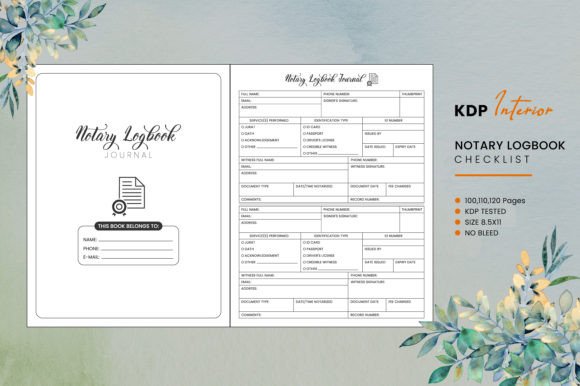
The act of notarization is a solemn one, creating a public record of a private transaction. States require notaries to maintain a journal of their acts for a period of years. This logbook is your first line of defense—it proves you performed your duties correctly and provides a verifiable trail if a document is ever challenged. A generic journal might suffice, but a purpose-built Notary Logbook Journal interior anticipates the exact information you need to capture: date, document type, signer names and addresses, identification details, fees charged, and signer signatures. This structured approach turns a legal obligation into a streamlined part of your workflow.
Scenarios Where a Dedicated Logbook Becomes Indispensable
Consider the mobile notary who travels to clients' homes or offices. Their journal is their mobile office record. Having a physically robust, clearly laid-out book means they can complete entries on-site, neatly and completely, without needing to transcribe notes later. For the notary working in a busy bank or law firm, where volume is high, the pre-formatted pages prevent omissions and ensure every field is filled consistently, which is crucial for compliance audits.
Another scenario involves notaries who specialize in particular fields. A notary focusing on real estate might see a high volume of deed-related notarizations. Their logbook, used over time, becomes a valuable historical record of their transactions, useful for their own business tracking alongside legal compliance. For the part-time or new notary, the structured layout of a KDP Interior for a notary journal acts as a guide, educating them on the necessary data points and fostering professional habits from the start.
Who Benefits From This Tailored Tool? Audiences You Might Not Expect
While the primary user is obviously the notary public, the benefits ripple outwards. Legal offices and corporate HR departments that employ in-house notaries benefit from the standardized records, making internal audits and record retrieval efficient. Independent paralegals and document preparation services often work closely with notaries; using a consistent, professional logbook enhances the credibility of their entire service chain.
Furthermore, consider the entrepreneurial angle. The Notary Logbook Journal – KDP Interior is itself a product designed for the Kindle Direct Publishing (KDP) ecosystem. Aspiring publishers and entrepreneurs looking to create useful, "low-content" books for niche professions find this interior template ready to use. It’s a PDF ready to upload, with a tested trim size of 8.5 x 11 inches, and options for 100, 110, or 120 pages. This allows them to quickly produce a professional product for the notary market without needing design skills, focusing instead on marketing and distribution on platforms like Amazon.
Practical Considerations Before Choosing or Using a Logbook Interior
Before utilizing a pre-made Notary Logbook Interior, a notary must check their specific state regulations. Some states have mandatory journal formats or require specific additional entries. While a good template covers universal needs, you must ensure it can accommodate your state’s unique rules, perhaps by leaving room for extra notes.
For the KDP publisher, practical considerations are different. They need to assess the market: is there demand for a physical, printable logbook in an increasingly digital world? The answer is often yes, as many notaries and legal professionals prefer a tangible, bound record book for its permanence and ease of use during in-person transactions. Choosing the right page count (100, 110, 120) depends on estimating a notary’s volume—a larger page count offers more value but a higher production cost. The fact that the interior is no bleed and KDP tested means it’s technically ready, but the publisher’s job is to ensure it’s marketed to the right, practical-minded audience.
The Strengths and Nuances of a Pre-Designed Solution
The core strength of a dedicated Notary Notebook Journal interior is its focus. It eliminates mental overhead. You don’t think about layout; you simply fill in the blanks. This reduces errors, saves time, and creates a uniform, professional appearance for your records. The high-resolution and clean design also matters if you choose to print it yourself—it results in a crisp, readable book that withstands daily use.
Potential limitations are tied to its static nature. As mentioned, it must align with state law. Also, a purely physical logbook doesn’t offer digital backup. Many notaries today complement their physical journal with digital scans or photos for extra security. The Notary Logbook Journal – KDP Interior serves as the primary, authoritative record, but savvy professionals often integrate it into a broader, hybrid system. For the publisher, the limitation is that it’s a template—success depends on your ability to reach the niche notary community through effective keywords and understanding their practical needs.
In everyday use, the journal becomes more than a compliance tool. It’s a tracker of your business growth. You can observe trends in the types of documents you notarize, track your fee income over time, and manage your schedule by reviewing past appointments. It evolves from a record book into a planner and organizer for your notary practice.
From Template to Tangible Tool: The Journey of a Logbook
The journey of the Notary Logbook Journal – KDP Interior file—from an editable EPS source file to a printed book on a notary’s desk—is a testament to modern print-on-demand (POD) publishing. An entrepreneur purchases the interior, perhaps customizes the cover, and uploads the ready-to-use PDF to KDP. When a notary searches for a professional logbook on Amazon, they find this physical product, order it, and it’s printed and shipped directly to them. This process provides the notary with a tool they might not have had the time to design themselves, and it creates a viable product business for the publisher. It’s a practical solution meeting a practical need.
Ultimately, whether you are the notary using the journal or the publisher creating it, the value lies in addressing a clear, experience-oriented problem. For the notary, it’s the problem of unreliable, non-compliant record-keeping. For the publisher, it’s the problem of creating a market-ready product without complex design. The Notary Logbook Journal interior sits at the intersection of these needs, providing a structured, simple, and professional foundation for the vital administrative work that underpins legal authenticity and trust.