Streamlining Academic Organization: The Power of a Designed School Planner
Anyone managing a school schedule knows the chaos that can ensue: assignment deadlines mixed with sports practices, parent-teacher conferences logged beside project due dates. A simple notebook can quickly become a mess of crossed-out notes and forgotten reminders. This is where a purpose-built School Planner comes into play. It’s not just a calendar; it’s a structured system designed to bring order to the academic year, for students, parents, and educators alike. When every hour and task has its designated place, the entire school experience becomes more manageable and less stressful.
Beyond the Student: Universal Applications for a Structured Planner
While the core image is a student tracking homework, the utility of a well-formatted planner extends far beyond the backpack. Consider the homeschooling parent coordinating lessons for multiple children across different grade levels. A single, unified planner allows them to map out weekly curricula, track progress, and schedule educational activities in one coherent space. For tutors and private instructors, such a planner becomes a client management tool, documenting session plans, progress notes, and payment schedules for each student. Even in broader professional settings, the clear temporal structure of a school planner can be adapted for project timelines, training schedules, or quarterly goal tracking, proving its framework is valuable for any time-bound endeavor.
The real benefit lies in the reduction of cognitive load. Instead of juggling disparate notes, apps, and memos, a user consolidates their academic or schedule-related information into a single, reliable repository. This consolidation minimizes errors, prevents overscheduling, and creates a visual map of commitments that is easy to review and adjust.
Key Features Translated into Real-World Usability
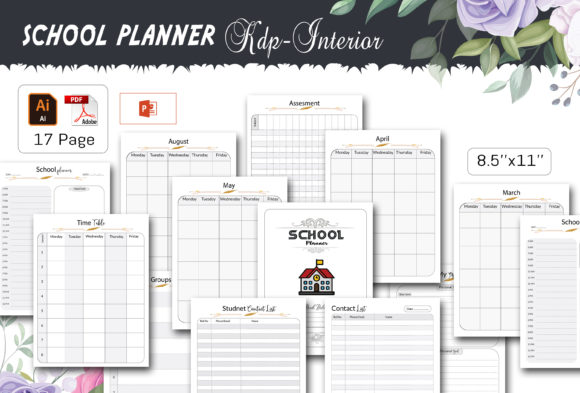
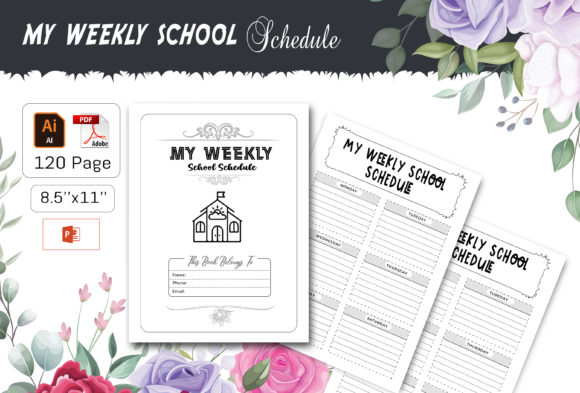
When evaluating a School Planner template, it’s crucial to understand how its specifications translate to daily use. A file size of 8.5 x 11 inches isn’t just a technical detail; it’s the standard for home printers and professional print shops, ensuring the final product is familiar and easy to handle. The inclusion of fully editable vector files means a creative entrepreneur can customize the planner’s aesthetics—changing colors, modifying layouts, or adding branding—without sacrificing quality or starting from scratch. This adaptability is key for those looking to sell personalized planners or adapt the template for a specific institutional use.
The promise of a "print-ready" PDF with no bleed is a practical consideration for the end user. It means you can hit print at home or at a local shop and get a perfectly aligned document without worrying about margins being cut off. This reliability removes a common technical hurdle. Meanwhile, the inclusion of high-quality 300 dpi JPEG images ensures that any visual elements remain sharp, whether viewed digitally or on paper. For the user, these features collectively mean the product works as intended without demanding technical expertise.
Considerations Before Implementing Your Planner System
Before committing to a particular School Planner template, think about your primary mode of engagement. Will this be a digital tool used on a tablet or screen during lessons? Or is it primarily a physical, printed booklet that will be carried around? The provided file formats—like PowerPoint (PPT) for easy textual edits or Illustrator (AI/EPS) for deep design changes—support different workflows. A teacher making weekly updates for a class might prefer the simplicity of PowerPoint, while a designer creating a branded product line will need the vector files.
Also, assess the scope of your needs. A 120-page structure offers ample space for a full academic year, including sections for monthly overviews, weekly details, project planning, and grade tracking. For a single student, this might be comprehensive. For a small school or tutoring business producing multiple copies, the editable nature allows for efficient bulk customization. The key is to match the template’s capacity and flexibility to your actual operational scale.
From Digital File to Tangible Tool: The Journey of Customization
The journey from downloading a template to using a finished planner highlights its practical value. A blogger focusing on educational productivity might download the files, customize a few pages with their own tips and branding, and then share it as a downloadable resource for their audience, building community and authority. A freelance educator could quickly tailor the planner for a specific course they teach, printing copies for each student as a professional, organized handout that enhances their service offering.
For the KDP (Kindle Direct Publishing) entrepreneur, this template is a ready-to-upload product interior. They can adjust colors and fonts, perhaps add a motivational quote section, and upload the print-ready PDF directly to Amazon. This turns a design asset into a commercial product with minimal technical barrier, enabling a small business owner to enter the educational printables market. In each case, the starting point is the same structured template, but the outcome is uniquely tailored to the user’s specific goals and context.
Connecting Structure to Outcomes: The Impact of Clear Planning
Ultimately, the value of any tool is measured by the outcomes it enables. A robust School Planner facilitates several tangible results. For a student, it can lead to improved time management, reducing last-minute cramming and forgotten assignments, thereby potentially improving academic performance and reducing stress. For a parent, it creates a central family hub for school logistics, making it easier to coordinate pick-ups, event attendance, and academic support.
In a commercial context, a seller on platforms like Etsy or Amazon using this template can create a consistent, professional product line. The high-quality, editable files allow for rapid iteration and variety—offering planners in different color schemes or with specialized sections—which can attract a wider customer base and build a reputable brand. The outcome here is business growth and customer satisfaction.
The common thread is that the planner provides a framework for order. It externalizes the schedule, making it objective, shareable, and reviewable. This shift from internal, scattered reminders to an external, organized system is what transforms potential chaos into managed calm, across countless personal, educational, and professional scenarios.